You Can't Build AI on a Mouldy House. Two Industry Voices on Why Data Comes First.
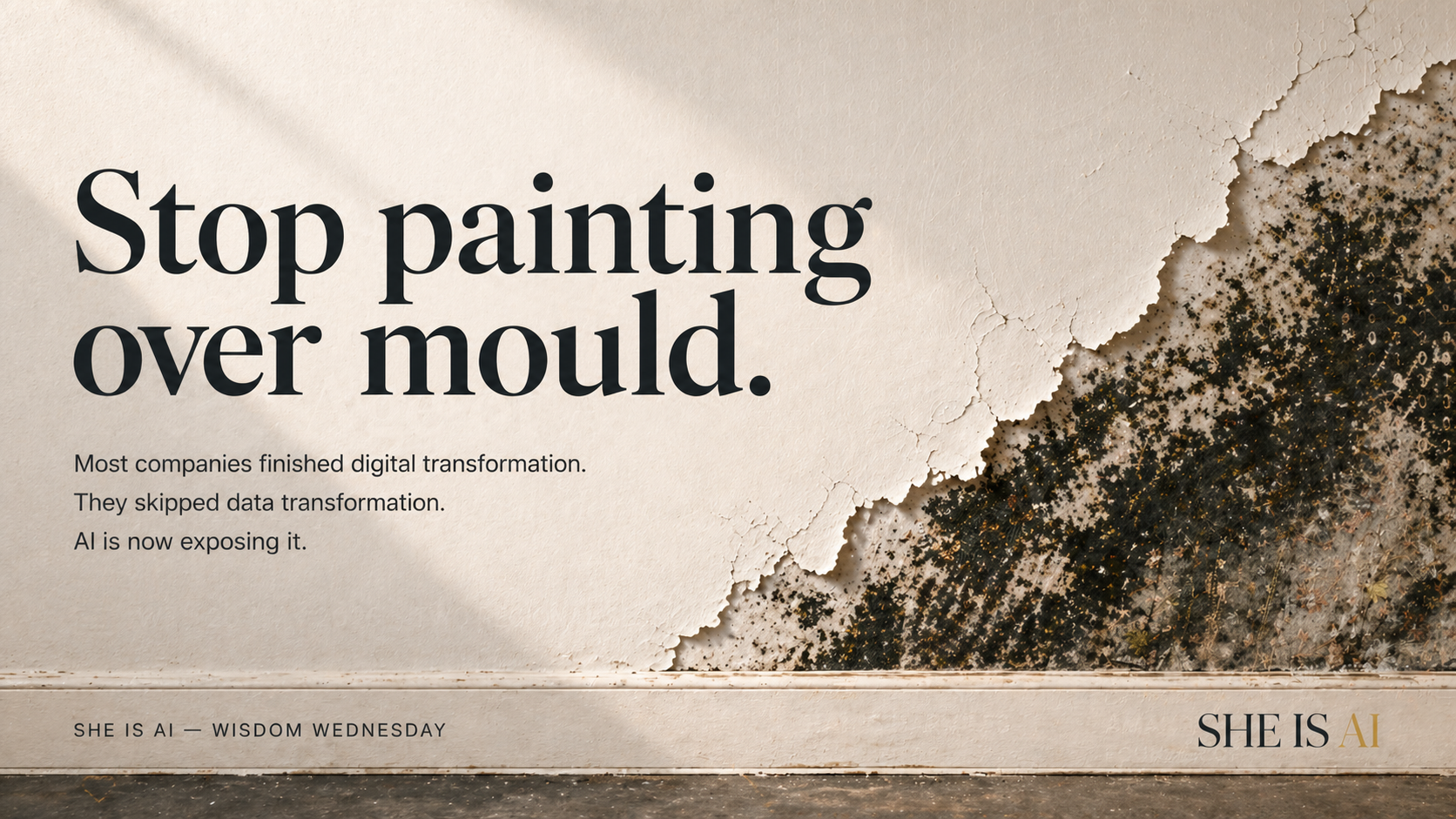
Conversations I've had this week with two senior industry voices, on two continents, both arrived at the same conclusion. Most companies are painting over mould.
I've been having conversations with industry pros this week and the same theme keeps coming up.
One is a corporate IT specialist who spent the last year researching data and information hygiene inside large enterprises. The other is a 30-year consulting veteran who worked inside some of the world's biggest firms before stepping out to help business founders fix the operational and data foundations of their companies.
Different countries. Different specialisms. Different angles. Both arrived at the same conclusion.
Companies want AI. They've got the licences. They've got the appetite. And their projects keep stalling; not because the tools don't work, but because the foundations underneath aren't there.
There's fundamental issues underlying before you just go and slap on a tool.
That's the conversation almost no one is having out loud right now.
The hype is loud. The foundations are quiet.
We're surrounded by what one of these voices called "AI slop" — the endless drumbeat of check out my tool, check out my tool, check out my tool. The bro-marketing webinars promising twenty-nine grand a month selling agents. The LinkedIn feed. The conference circuit. The noise.
He told me about a former client — a friend, actually — who came to him asking for AI agents and automations. He said: "Hey, we're going to be your data and AI fixes before you do any AI." The friend wasn't interested. Wanted the shiny stuff. His response: "What's the point of putting in AI if your data doesn't work? You're going to be pulling crap, and you're going to be generating crap."
They parted ways.
The other voice — the IT researcher — found the same pattern at scale. Her conclusion after a year of research was quiet and devastating. Nobody is doing the foundational data work. Companies are converting to AI on top of complete mess. No SOPs. No clean data. No documented processes. No shared infrastructure. They're building intelligent systems on rotting foundations.
Two senior voices. Two continents. Same conclusion. We're painting over mould.
What digital transformation skipped
Most companies finished their digital transformation between 2018 and 2022. Cloud. SaaS. Microsoft 365. Tick. Done. The PowerPoint slide got presented to the board. The consulting firm got paid.
What they skipped — what almost nobody named — was the data transformation. The information architecture. The governance policies. The actual cultural work of getting one department's knowledge into the whole business. The breaking of silos. The shared vocabulary. The Wi-Fi that actually reaches the warehouse.
Now AI shows up. And it's a magnifying glass.
Every project that stalls, stalls in the same place. The data isn't clean. The processes aren't documented. The departments don't share a database. The Wi-Fi is patchy. The team has no shared language for what an "agent" or "workflow" or "automation" actually means inside their business. The tools work. The foundations don't.
The deeper question nobody's asking
Underneath the data argument, there's a deeper one I think we keep dodging.
People talk about AI as if it's either a robot worker or a tool. But is a human a worker or a tool? Is the IoT sensor on the factory floor a worker or a tool? The drone surveying the construction site? The agent running overnight in your CRM?
The workforce was already a network of humans, machines, sensors, and software long before AI got popular. We just hadn't named it that way. AI didn't create the network. It just made the network visible.
The framing matters because it changes how you design the whole system — who has accountability, what gets documented, where the data sits, who fixes it when it breaks. And how does your environment, your country, your culture, your community actually communicate? What's written down and what only lives in someone's head? Where are the silos, and are you breaking them down or building new ones with every shiny new tool you bolt on?
Two voices, one conclusion
Both of these industry pros work in different markets, different countries, with different client books. They arrived at the same conclusion from completely different routes.
You can't outsource the foundation work to a tool. You can't bolt automation onto chaos and call it transformation. You can't build intelligent systems on a Wi-Fi connection that drops every time it rains.
The companies winning with AI right now aren't the ones with the biggest tool stack. They're the ones who quietly went back and did the data transformation work everyone else skipped.
This is the conversation we're having inside SHE IS AI right now — practical, grounded, and centred on getting the foundations right before the fancy stuff. If that's the work you're trying to do, come and join us.