The discernment gap - The biggest AI skill gap in 2026 is not technical.
There is a assumption sitting underneath almost every AI training programme sold in the last three years. It is rarely stated, because stating it would make it easier to argue with.
The assumption is that the problem is access.
That people are behind because they have not been shown the tools. That once someone knows which model to use, which prompt to write, which integration to set up, the gap closes and they are fluent.
It is a reasonable thing to have believed in 2023. It is no longer what the evidence looks like.
What actually happens in the room
Over two years of teaching this to more than five hundred people, across classrooms, boardrooms and community halls, the same sequence repeats.
People learn the tool faster than expected. Considerably faster. The interface is designed to be learnable and most adults get there inside an hour.
Then, almost immediately, they ask a question the training does not answer.
Should I be using this for that. What do I do about the client data. How do I know when it is wrong. My daughter is using this for homework, is that fine.
Every one of those is a judgment question wearing the costume of a technical one. And the course, built to teach capability, has nothing to say.
That is the discernment gap. It is not a gap in access. It is a gap in the ability to decide.
Why the industry keeps building the wrong thing
Not out of bad faith. Out of what is easy to sell.
Capability is legible. It can be demonstrated in a webinar, screenshotted, packaged into a module, and assessed with a quiz. It produces a certificate that looks like something.
Judgment is none of those things. It is slow to develop, awkward to assess, and impossible to demo. It also cannot be delivered as a pre-recorded video, because the useful version of it is always a response to a specific situation somebody in the room is actually facing.
So the market built what the market could measure. And the result is an entire education layer organised around the part of AI that expires fastest.
There is a second reason, less comfortable. Tool training creates repeat customers. Someone who completes a course on a specific interface will need another course when that interface changes, which it will, within months. Judgment, once developed, does not send anyone back for a refresher.
What discernment consists of
It resolves into four capacities, and all four are teachable.
Knowing what not to put in. Client records. Student data. Health information. Anything covered by an agreement someone signed. This is not a policy problem, it is a recognition problem, and it happens in the second before the paste rather than in the audit afterwards.
Knowing when the output is confidently wrong. Fluent language reads as authoritative regardless of accuracy. The people who catch errors are the ones holding enough domain knowledge to notice that the shape of an answer is right and the substance is not. Which means AI capability sits on top of expertise rather than replacing it, a fact most training quietly avoids.
Knowing who is absent. Whose data trained this. Whose values are encoded in the default behaviour. Who is most exposed if the governance around it fails. Black and Brown communities are consistently missing from the design tables where these systems are shaped, and consistently over-represented among those who carry the cost when governance fails. Asking who is not here is a discipline, and it can be built into how someone works rather than bolted on as a values statement.
Knowing when the human answer is correct. Some work is faster with AI and worse with AI. The condolence note. The performance conversation. The first draft of the thing you needed to think your way through rather than around. Discernment includes the decision to stop.
The asymmetry that matters most
If someone learns AI without judgment, they carry their own errors. That is a contained problem.
If someone teaches AI without judgment, every person they train inherits those errors and teaches them forward. The problem stops being contained and starts compounding.
This is the argument for holding people who teach to a higher standard than people who learn. Not because teachers are more important, but because their mistakes replicate.
Capability alone does not clear that bar. Being good with a technology does not qualify someone to hand it to other people. The authority to teach is something earned through demonstrated readiness, granted deliberately, and held to a standard that somebody is accountable for.
Very little in the current AI education market works that way. Most of it will sell a train-the-trainer certification to anyone with a card.
What we built instead
The SHE IS AI Applied Intelligence Pathway™ is organised around judgment rather than software.
Catalyst is the entry cohort. Six weeks, twelve modules, taught live. Live matters here, because the discernment questions people bring are specific and a recording cannot answer them.
Participants do not leave with notes. They leave with eight working artefacts: an AI values statement, a personal governance framework, a responsible use checklist, an authentic voice prompt portfolio, an integration plan, an ethical decision-making guide, a pathway map, and an applied use case project. Work a manager can read and a colleague can use.
There is no checkout button. Entry is by application and placement assessment, because a programme that sells any level to anyone is selling access, not standards.
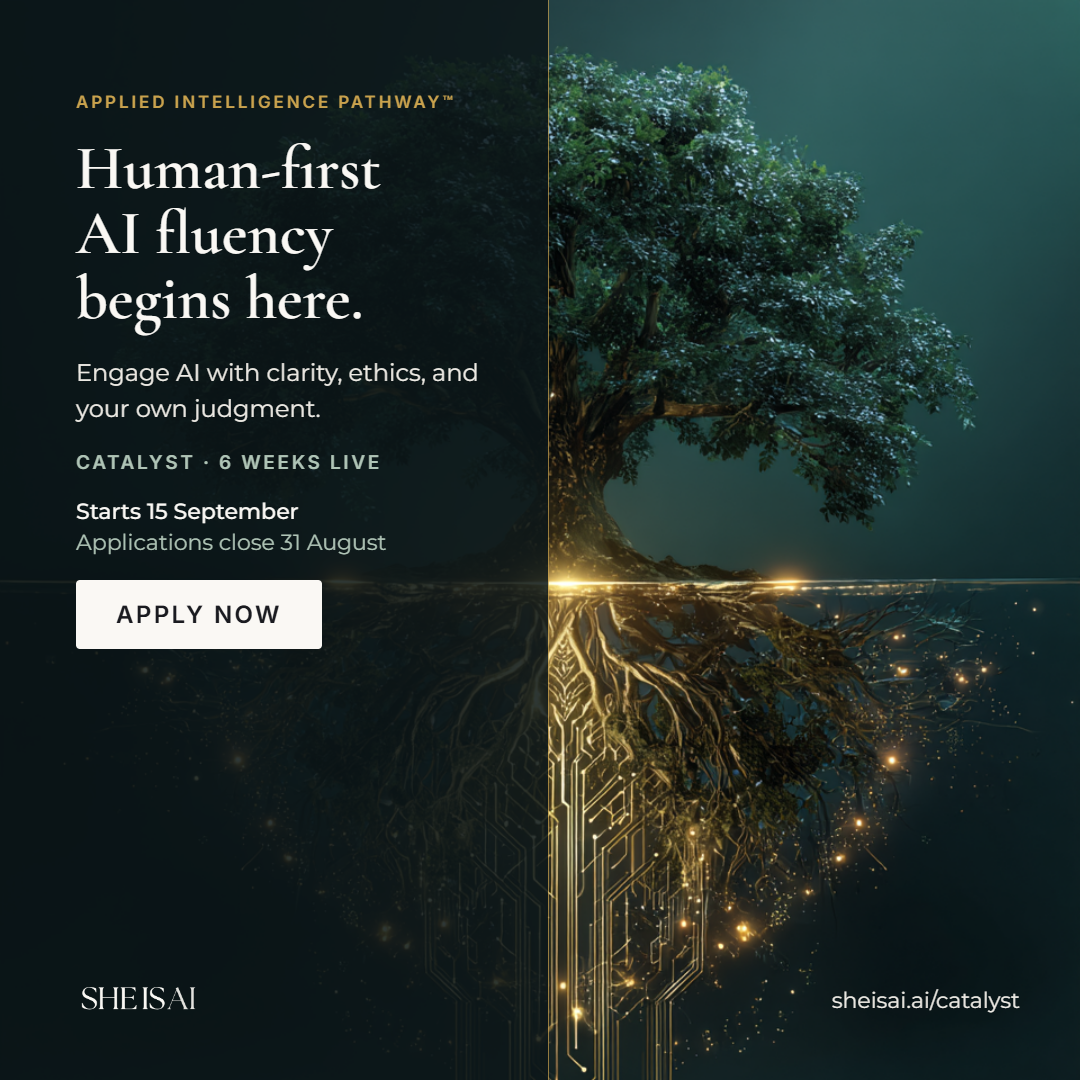
Catalyst starts 15 September.
The part that does not expire
The tools will keep changing, and faster than any curriculum can track. That is not a problem to solve. It is the condition.
What holds its value is the judgment about whether to reach for them at all. It is the least taught thing in AI education and the only part that will still be worth something in five years.
If you are going to teach this to other people, it is the part worth being certified in.