From tool-chasing to discernment: the AI skill nobody is certifying
There is a particular kind of exhaustion showing up in classrooms and boardrooms this year. It is not that people cannot use AI. It is that they cannot tell whether they should.
Ask a room of educators or managers what they need and most will say a course on the newest tool. What they usually need is something harder to buy: a way of deciding when to reach for the technology at all, when to slow down, and when the answer is a conversation rather than a prompt.
That capacity has a name. It is discernment. And it is the single most neglected outcome in AI education right now.
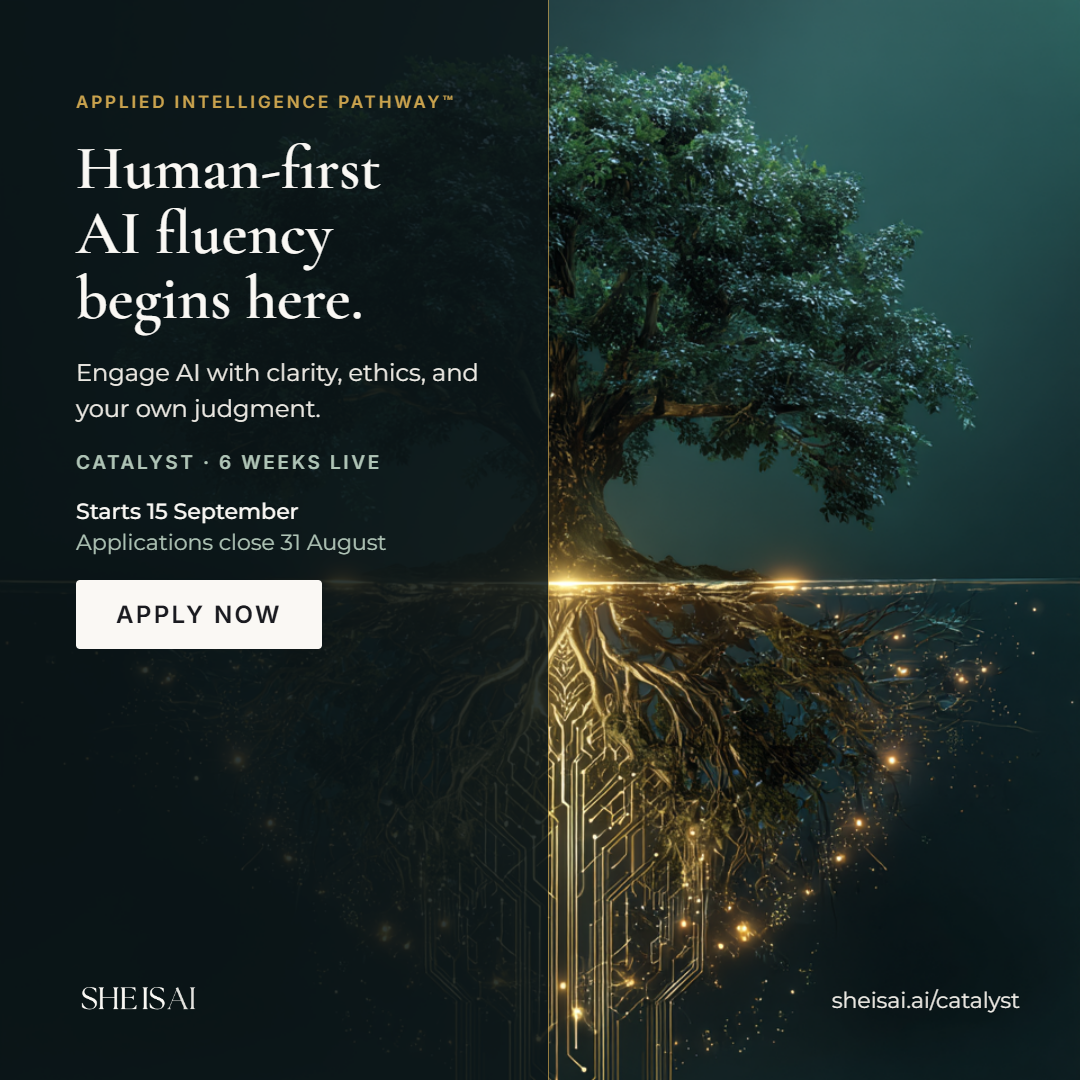
Applications are open for the SHE IS AI Applied Intelligence Pathway™ →
The shelf life problem
Tool training has a short and shortening shelf life
A course built around a specific interface is out of date the moment that interface ships an update. The person who completed it has a certificate describing a version of software that no longer exists. They come back six months later for the next course, and the cycle repeats
This is why so much AI training feels like running to stand still. It is not a failure of effort. It is a failure of what was chosen as the outcome
Knowing which tool to use is a search away. Knowing when not to use one is judgment, and judgment does not expire.
What discernment actually looks like
It is not abstract. It shows up as a set of concrete decisions people make dozens of times a week.
Knowing what not to put in. Client data, student records, health information, anything covered by an agreement you signed. Discernment is recognising the moment before the paste, not the audit afterwards.
Knowing when the output is confidently wrong. Fluent text reads as authoritative. The people who catch errors are the ones who already hold enough domain knowledge to notice when the shape of an answer is right and the substance is not.
Knowing who is missing from the picture. Whose data trained this. Whose values are encoded in the default. Who is most exposed if the governance around it fails. Communities that were absent from the design table tend to carry the cost when things go wrong, and asking that question early is a skill that can be taught.
Knowing when the human answer is the correct one. Some work is faster with AI and worse with AI. Condolence notes. Performance conversations. The first draft of something you needed to think your way through. Discernment includes the decision to close the laptop.
None of that is technical. All of it is teachable. Almost none of it is being certified.
Why this matters more for educators than anyone else
If you are learning AI for your own work, a gap in judgment costs you your own mistakes.
If you are teaching it, a gap in judgment gets copied. Every person you train inherits your blind spots along with your frameworks, and they teach it forward. The error compounds.
This is the argument for setting a higher bar for the people who teach than for the people who learn, and it is why capability alone is not enough. Being good with AI does not make someone qualified to teach it. Authority to teach is something earned through demonstrated readiness, granted deliberately, and held to a standard.
That principle is the foundation the SHE IS AI Applied Intelligence Pathway™ is built on.
What an AI train the trainer certification should include
If you are comparing programmes, these are reasonable things to require.
A placement process, not a checkout button. A programme that lets anyone buy any level is selling access, not standards. Placement by demonstrated experience is slower and it is the point.
Named faculty who are accountable. You should be able to see who teaches, what they have built, and what they are answerable for.
Artefacts, not attendance. At the end you should hold work you can use. An AI values statement. A personal governance framework. A responsible use checklist. An integration plan. Things a manager can read.
Ethics as structure, not a closing module. If governance appears once, near the end, as a compliance slide, it was decoration.
A live cohort. AI education delivered as pre-recorded video ages at the same rate as the tools it describes. Live teaching lets the curriculum answer the room.
Where the Pathway starts
The Applied Intelligence Pathway™ has three entry points, and you do not choose between them. You apply once, and placement is based on what you have actually done.
Catalyst is for people building the judgment to use AI with clarity and ethics intact. Six weeks, twelve modules, live.
Architect is for people already teaching or facilitating AI who want a proper framework underneath the work.
Steward is for people who will hold the standard for others.
Catalyst opens first. Applications are open now, and the cohort starts 15 September.
The short version
The tools will keep changing. The judgment about when and whether to use them is the part that holds its value, and it is the part almost nobody is teaching.
If you are going to teach AI to other people, that is the part you want to be certified in.